Picture Slide Show Coming Soon 

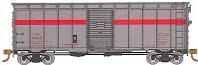
In 1937, the AAR approved a new standard box car. The design itself was an update of the 1932 ARA box car design, with increased height and width, and newer components. 

While the 1932 ARA car received some acceptance by the railroads, the 1937 AAR design was the first standard steel box car built in large quantities by many roads including Canadian National and Canadian Pacific, rostering nearly 30,000 cars between them between 1937 and 1944.
 
The Candian cars have some unique features. They were slow to adopt the new Rectangular Panel roof, instead using an earlier Flat-Panel design until as late as 1943. They used unique ladders with integral stirrup steps, including end ladders, and since they did not have poling pockets and stirrup steps, they lacked the side-sill 'tabs' at the corners of the cars. They also continued building the 1937 AAR cars as late as 1944, when other roads had built 'Modified 1937 AAR' cars starting in 1941. Both roads switched to and  the 1944 'Postwar' design in 1947.
 
Due to their numbers, the cars were a common sight along not only Canadian roads, but on US roads as well.

Latest Release - May 2011
SRP $44.84


Available Models


GOLD SERIES


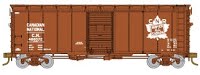
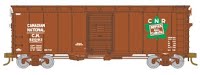
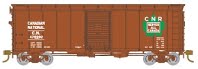
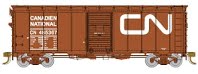
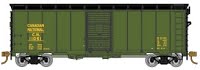
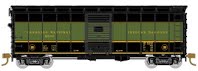
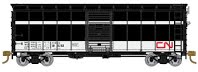
Canadian National NSC-built Cars

Beginning in 1937, the CN rostered over 18,000 40' box cars based on the 1937 AAR design. These cars had a 10' IH and 6' doors.
 
The cars were built with Hutchins, Flat Panel, or Rectangular Panel roofs; Ajax or Universal power hand brakes; and wood running boards. Trucks were either AAR cast sideframe or National Type-B.
 
Most of the cars built between 1937 and 1940 used the standard 4/5 dreadnaught ends of the era. However, over one-third of these cars built by the National Steel Car (NSC) Company using their proprietary ends instead.
 
The True Line Trains cars model these unique Canadian cars.

NSC-built CN Boxcars 1937-1941 w/ Flat Panel Roof
472000-472999 - built Oct 1937 - Feb 1938 - NSC #1 ends
475300-475999 - built May-Jun 1937 - NSC #1 ends
476625-477349 - built May-Jul 1937 - NSC #2 ends
480125-480714 - built Dec 1939- Feb 1941 - NSC #2 ends
NSC-built CN Boxcars 1944-1947 w/ Rectangular Panel Roof
481815-482714 - built Feb-Apr 1943 - NSC #2 ends
484165-485514 - built Feb-May 1944 - NSC #2 ends
486565-487264 - built May-Jun 1944 - NSC #2 ends
520000-520999 - built Jun-Nov 1945 - NSC #2 ends
521000-521499 - built Dec 1945-Jan 1947 - NSC #2 ends
521497 and 52198 were built with experimental aluminum sides.

Paint Schemes*
1937 - Canadian National, no herald
1943 - White Maple Leaf, tilted box
1945 - Green Maple Leaf, tilted box
1954 - Green Maple Leaf, straight box
1961 - Wet Noodle
*The dates listed are approximate dates for when the scheme was first applied.
Older paint schemes were still seen for many years after a new scheme was adopted. 


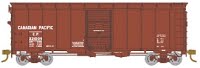
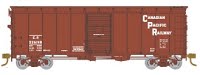
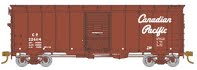
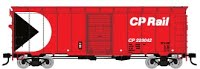
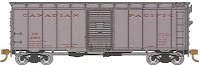
Canadian Pacific CC&F-built Cars

The Canadian Pacific rostered over 9,000 of these cars with deliveries beginning in 1937. Although 1,950 of the cars were built by NSC as on the Canadian National, the majority of the cars were built by Candian Car & Foundry, accounting for more than two thirds (6,550). The final 950 cars were built by Eastern Car Company.
 
All of the Canadian Pacific cars used an unusual 5/5 welded dreadnaught end, instead of the more common 4/5 riveted dreadnaught end. Even the NSC and ECC-built cars used these ends. The utilized the Flat Panel roof until 1940 and did not switch to the Rectangular Panel roof until 1941.
 
The True Line Trains cars model the CC&F-built cars with the appropriate roof. 

CC&F-built CP Boxcars 1937-1940 w/ Flat Panel Roof
222000-222949 - built Jun-Aug 1938
223450-223949 - built Feb-Mar 1940
226000-227699 - built Jun-Oct 1937
228200-228799 - built Nov-Dec 1937
CC&F-built CP Boxcars 1941-1945 w/ Rectangular Panel Roof
248350-248999 - built Oct-Nov 1943
249000-249499 - built Oct-Nov 1941
249500-250499 - built Aug-Sep 1944
250500-251249 - built Mar-May 1945

Paint Schemes*
1937 - Canadian Pacific, no herald
1947 - "Spans the World"
1951 - "Stepped" roadname
1959 - "Script" roadname
1968 - later - Multi-Mark
*The dates listed are approximate dates for when the scheme was first applied.
Older paint schemes were still seen for many years after a new scheme was adopted.